logo

details van de producten

Created with Pixso. Thuis Created with Pixso. Producten Created with Pixso.
De Trillingsisolator van de draadkabel
Created with Pixso.

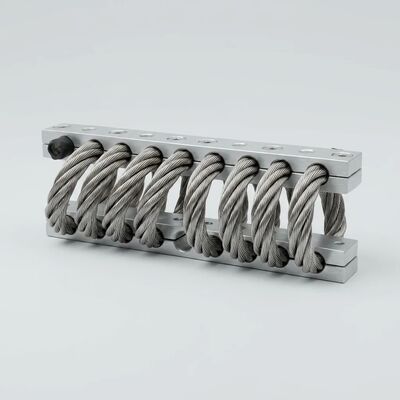
JGX-1278D-235B Zero-Maintenance Wire Rope Isolator 235N Dual-Action Shock Vibration Control 95mm for Equipment

JGX-1278D-235B Zero-Maintenance Wire Rope Isolator 235N Dual-Action Shock Vibration Control 95mm for Equipment

Merknaam: Hoan
Modelnummer: JGX-1278D-235B
MOQ: 10 stuks
Betalingsvoorwaarden: L/C, D/A, D/P, T/T, Western Union
Gedetailleerde informatie
Plaats van herkomst:
Shaanxi, China
Certificering:
ISO 9001:2015
Model:
JGX-1278D-235B
Kabeldiameter:
12,7 mm
Aantal lussen:
8
Maximale statische belasting (verticaal):
235N
Maximale vervorming (verticaal):
48.8mm
Trillingstijfheid (verticaal):
457 KN/m
Schokstijfheid (verticaal):
196 KN/m
Totale hoogte (H):
95 mm ±3,30 mm
Totale breedte (W):
121 mm
Gewicht per eenheid:
2,22 kg
Montagegat:
φ9,0 mm door gat
Draadmaat:
M8 × 1,25
Verzinkhoek:
90°
Montage opties:
A, B, C, D, E, S
Materiaal van kabel:
roestvrij staal 304
Materiaal van bevestigingsstangen:
Roestvrij staal 304 of aluminiumlegering
Oppervlaktebehandeling (aluminium):
Wit anodiseren / hard anodiseren
Temperatuurbereik:
-180°C tot +300°C
Sollicitatie:
Industriële machines, pompen, compressoren, generatoren, HVAC-systemen
Markeren:

Zero-Maintenance Wire Rope Isolator

,

Dual-Action Shock Vibration Control

,

Lifetime Savings Cable Shock Mount

Productbeschrijving

JGX-1278D-235B Zero-Maintenance Wire Rope Vibration Isolator — Dual-Action Shock Absorption & Lifetime Cost Reduction for Industrial Machinery

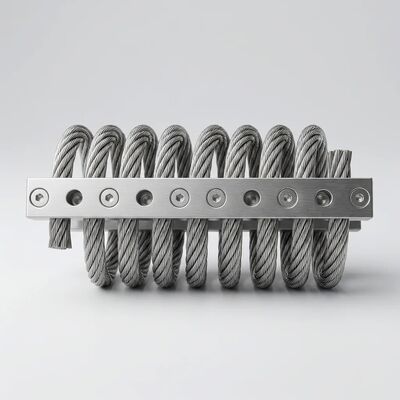
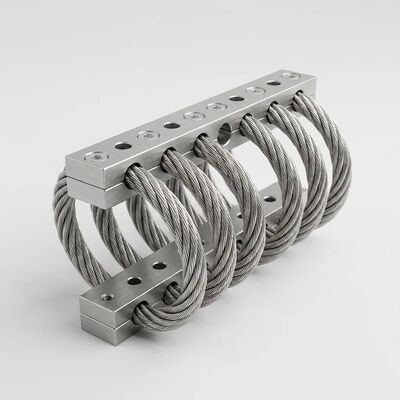
The JGX-1278D-235B offers a fundamentally different value proposition in industrial vibration isolation: install once, forget forever. By combining dual-action shock-and-vibration control with a completely passive all-metal architecture, this 235N-rated wire rope isolator eliminates every category of recurring ownership cost—scheduled replacement, labor for inspection and change-out, production downtime for servicing, spare parts inventory, and disposal of degraded elastomeric waste. With an overall height of 95mm, width of 121mm, and mass of 2.22kg, the JGX-1278D-235B fits standard industrial mounting footprints while delivering a projected service life that exceeds 25 years in normal operating conditions—typically outlasting the equipment it protects.

The True Cost of Vibration Isolation — Why Purchase Price Is the Wrong Metric

Procurement teams that evaluate isolators on unit acquisition cost alone make a systematically expensive mistake. Isolators are infrastructure components—not consumables—and their real cost is measured in lifecycle terms. The following analysis compares a typical 24-point industrial installation over a 10-year operating horizon:

Table 1: 10-Year Total Cost of Ownership — Elastomeric Mounts vs. JGX-1278D-235B (24-Point Installation)
Cost Element (10-Year Horizon) Elastomeric Mounts JGX-1278D-235B Wire Rope Isolators
Initial purchase (24 units * unit cost) $X — Lower unit price $1.5-2.0X — Higher unit price, one-time expense
Scheduled replacement at Year 4 24 units * unit cost + labor for change-out + production downtime (8-24 hours) None — no scheduled replacement interval
Scheduled replacement at Year 8 24 units * unit cost + labor + downtime (repeat) None
Quarterly inspection labor (10 years * 4 inspections) 40 inspections * 1.0 hour * technician rate (measure sag, check cracks, document) 40 inspections * 0.15 hour * technician rate (visual check only, no measurement)
Spare parts inventory carrying cost 6-12 spare mounts in stockroom; inventory management overhead Zero — no need to stock replacements
Emergency call-out risk (unplanned failure) Moderate — catastrophic rubber tear can occur without warning Near-zero — progressive wire wear provides months of visual warning before functional compromise
Disposal cost Bonded rubber-metal waste stream; special handling required in some jurisdictions 100% recyclable stainless steel and aluminum — standard scrap metal stream
Estimated 10-Year TCO Multiple of Initial Purchase 3.0-5.0* unit acquisition cost 1.0-1.2* unit acquisition cost
Remote-installation economics: The TCO advantage becomes even more pronounced for installations at difficult-to-access locations. Consider an offshore platform auxiliary equipment skid, a desert pumping station, or an underground machinery vault: the cost of mobilizing a service crew—helicopter transfer, safety briefing, confined-space permit, equipment shutdown coordination—can exceed the entire initial isolator procurement by a factor of 5-10*. In these scenarios, the "install-and-forget" character of the JGX-1278D-235B delivers a lifecycle cost advantage that can approach 80% versus elastomeric alternatives.

Dual-Action Damping — How One Device Handles Both Routine Vibration and Shock Events

Conventional isolation strategies address vibration and shock as separate problems requiring separate hardware: soft mounts for continuous vibration, stiff snubbers for occasional impacts. The JGX-1278D-235B solves both problems with a single physical mechanism—Coulomb friction at strand-to-strand contact interfaces within the multi-wire stainless steel cable helix.

Mode 1: Continuous Vibration Damping (Normal Operation)

During routine equipment operation—a pump running at constant speed, a compressor cycling, a generator set producing steady power—the equipment generates low-amplitude, relatively high-frequency vibration. This vibration causes micro-displacements (typically 5-50 μm) between individual stainless steel wires within each of the 7 strands that make up the cable. At these contact points, solid friction converts kinetic energy into negligible heat. The harder the equipment vibrates, the more wire-to-wire contact interfaces engage, creating a self-regulating damping effect that requires no tuning, no adjustment, and no external power source.

Mode 2: Transient Shock Absorption (Impact Events)

When a sudden high-energy input occurs—a pump water hammer event, compressor slugging, structural collision during material handling, or a seismic tremor—the cable undergoes geometric reconfiguration at the macro scale. Individual strands slide and reposition within the multi-wire bundle, absorbing the impulse energy through combined friction (strand-level) and elastic deformation (helix-level). The figure-eight winding geometry provides a progressive stiffness increase as deformation grows, delivering inherent overload protection without mechanical hard-stops. Once the transient event concludes, the cable returns to its original geometry without permanent set.

JGX-1278D-235B — Complete Multi-Axis Performance Data

All load ratings are based on Type II characterization testing. Values represent the isolator's nominal performance with aluminum retaining bars at 23°C ambient temperature:

Table 2: Load-Deflection and Stiffness Characterization
Loading Direction Max Static Load Max Deformation Vibration Stiffness Shock Stiffness Stiffness Ratio (Vib/Shock)
Vertical — Compression 235 N 48.8 mm 457 KN/m 196 KN/m 2.33*
45° Angled — Combined 165.7 N 68.6 mm 259 KN/m 98 KN/m 2.64*
Lateral — Shear / Roll 122.6 N 50.8 mm 121 KN/m 121 KN/m 1.00*
Interpreting the stiffness ratios: The vertical vibration-to-shock stiffness ratio of 2.33* means the isolator is more than twice as stiff during everyday vibration as it is during a shock event. This is the defining characteristic of wire rope isolators: they provide firm, stable support for normal operation while becoming compliant and energy-absorbing during transient overload conditions. In the 45° combined loading direction, this differential widens to 2.64*—making the JGX-1278D-235B particularly effective for bracket-mounted equipment where combined compression-and-shear loads dominate. The lateral 1.00* ratio reflects the symmetric shear behavior of the figure-eight cable geometry.

Dimensional Specifications & Interface Details

Table 3: Physical and Mechanical Interface
Parameter Value Detail
Model Designation JGX-1278D-235B 1278 = 12.7mm cable, 8 loops; 235 = rated vertical load in Newtons
Height (H) 95mm ±3.30mm Unloaded free height
Width (W) 121mm End-to-end bar length
Mass 2.22 kg With aluminum bars; approximately 3.0 kg with 304 SS bar option
Cable Diameter 12.7mm 7 strands * 19 wires per strand; Type 304 SS
Loop Count 8 Figure-eight helical winding pattern
Mounting Hole φ9.0mm (+0.13/-0.38) Through hole, countersunk at 90°
Thread M8 * 1.25 ISO metric coarse; tapped in bar
Mounting Configurations A, B, C, D, E, S 6 standard variants covering all common installation geometries

Environment-Specific Durability — Where Install-and-Forget Matters Most

Table 4: Challenging Installation Environments and JGX-1278D-235B Response
Environment Conventional Mount Failure Mode JGX-1278D-235B All-Metal Solution
Remote desert pump station
(50°C day / 5°C night; UV index 11+; service visit = 8-hour drive each way)
Rubber surface cracking from ozone + UV within 24 months; thermal cycling accelerates bond-line fatigue; sending a two-person crew for replacement costs more than the mounts themselves Zero UV/ozone degradation; 304 SS and 6061-T6 aluminum both handle 45°C diurnal thermal swing without property change; no service visit required—ever
Arctic monitoring instrumentation
(-55°C winter ambient; helicopter access only November-April)
Elastomer glass-transition temperature reached at approximately -40°C to -50°C; mount becomes rigid and loses all damping capability precisely when equipment protection is most critical 304 SS retains full ductility and elastic modulus to -180°C; damping performance is actually enhanced at cryogenic temperatures due to increased inter-strand friction coefficient
Offshore platform — commercial marine
(Salt fog 365 days/year; helicopter logistics for all maintenance; confined-space work permits required)
Salt-spray corrosion at rubber-to-metal bond interface causes progressive delamination; replacement requires helicopter crew transfer, permit-to-work, and equipment shutdown coordination No bond interface to corrode; 304 SS passive oxide layer self-passivates when scratched; visual inspection from walkway—no confined-space entry needed
Underground wastewater lift station vault
(100% RH, H₂S atmosphere, confined-space entry permit required for any physical access)
Hydrogen sulfide attacks rubber compounding; humidity accelerates bond-line corrosion; every inspection or replacement requires gas monitoring, ventilation, harness, and standby person 304 SS is H₂S resistant at ambient temperature; no rubber to degrade; annual visual inspection from vault entrance hatch—no entry required
Food & beverage processing line
(Daily caustic washdown at 80°C; FDA/USDA hygiene requirements; audit trail for all equipment contact materials)
Rubber mounts absorb cleaning chemicals, swell, and shed elastomer particles into the production environment—a contamination risk. Mount replacement every 2-3 years as part of preventive maintenance program. 304 SS is CIP (clean-in-place) compatible with all standard food-industry cleaning regimes; zero particle shedding; fully traceable material certification available; clean design with no crevices to harbor bacteria
Chemical processing plant
(Solvent-laden atmosphere; occasional spill contact; ATEX/IECEx zoning for potentially hazardous atmospheres)
Solvent vapor absorption causes rubber volume swell of 20-60%; mount load rating becomes unpredictable within weeks of installation; frequent replacement is the only risk-management strategy 304 SS is impervious to all common industrial solvents; load rating is stable and predictable for the full service life; all-metal construction eliminates static-charge accumulation risk

Retaining Bar Material Selection Guide

Table 5: Bar Configuration Decision Matrix
Config Material Finish Hardness Corrosion Resistance Weight Best Application
A — Standard 6061-T6 Aluminum White Anodize 10-15μm Moderate Good (indoor) Lightest Data centers, indoor factories, climate-controlled enclosures
B — Hard 6061-T6 Aluminum Hard Anodize 25-50μm High (350-500 HV) Good (outdoor) Light Outdoor equipment, abrasive environments, high-fretting potential
C — Marine 304 Stainless Steel None (passive Cr₂O₃ layer) High Excellent (offshore) Heaviest (~35% more) Coastal, offshore, chemical, food, pharmaceutical—any environment where corrosion risk dominates all other considerations

JGX-1278 Full Series Reference

Table 6: Complete JGX-1278 Product Family — Load Rating Continuum
Model Vertical Load (N) H (mm) W (mm) Mass (kg) Optimal Equipment Weight Range (kg)*
JGX-1278D-370B 370 76 92 1.81 15-26 kg per mount
JGX-1278D-310B 310 83 102 1.91 13-22 kg per mount
JGX-1278D-292B 292 89 105 2.00 12-21 kg per mount
★ JGX-1278D-235B 235 95 121 2.22 10-17 kg per mount
JGX-1278D-199B 199 108 133 2.40 8-14 kg per mount
JGX-1278D-176B 176 124 144 2.70 7-12 kg per mount
JGX-1278D-154B 154 137 156 2.90 6-11 kg per mount
JGX-1278D-122B 122 155 180 3.09 5-9 kg per mount

*Optimal range calculated at 40-70% of rated load for best damping performance. Actual selection should account for load distribution across multiple mounting points, dynamic loads during operation, and any asymmetry in equipment center of gravity.

Sector-Specific Applications — Engineered for Continuous Industrial Duty

Table 7: Industry Application Map
Industry Equipment Vibration Source JGX-1278D-235B Value
Water & Wastewater Centrifugal pumps, aeration blowers, chemical dosing skids Impeller imbalance, fluid turbulence, pipe resonance 24/7 wet-environment durability; H₂S resistant; zero-maintenance for unmanned stations
HVAC & Refrigeration Chillers, cooling towers, air handlers, condenser fans Compressor pulsation, fan imbalance, structural transmission Rooftop weatherproof; seasonal temperature cycling immunity; no protective covers needed
Compressed Air Rotary screw & reciprocating compressors, dryers, receiver tanks Piston inertial forces, screw pulsation, pressure vessel resonance Handles start-up torque shock and continuous run vibration within one device
Distributed Power Diesel & gas generator sets, cogeneration modules, microturbines Engine firing pulses, rotor imbalance, load-step transients High-temperature proximity tolerance; fuel/oil spray resistance; non-combustible construction
Mining & Aggregate Crusher drives, screen frames, conveyor gearmotors, slurry pumps Impact loading, belt imbalance, slurry pulsation Abrasion-resistant; no lubrication points to clog; outdoor mine-site exposure rated
Oil & Gas Midstream Pipeline booster pumps, meter skids, valve actuator panels Flow-induced vibration, pressure pulsation, pump cavitation events Full hydrocarbon immersion tolerance; hazardous-area compatibility
Pulp & Paper Refiner motors, calendar drives, dryer bearing housings, winders Roll imbalance, drive-train vibration, steam-system transients High-humidity endurance at elevated temperature; bleaching chemical resistant
Marine & Ports Crane control enclosures, ship-to-shore gantry drives, conveyor motor bases Impact loading from container handling, structural vibration from nearby machinery Salt-atmosphere immune; handles multi-directional impacts from container handling cycles

Performance Characteristics Summary

  • Lifetime zero-maintenance: No scheduled inspection, no re-torque, no lubrication, no replacement. Visual walk-by check during routine equipment rounds is all that is required. Projected >25-year service life under rated conditions.
  • Non-linear dual-action response: 2.33* stiffness differential between vibration and shock modes in the vertical direction—stiff for everyday operation, compliant for transient impacts. A single device performs the work of a vibration mount plus a shock absorber.
  • Hysteretic damping: Coulomb friction mechanism delivers 10-25% of critical damping without external dashpots or tuned-mass systems. Damping is amplitude-proportional—self-regulating without external control.
  • Extreme thermal envelope: -180°C to +300°C operating range. No cold embrittlement; no hot softening. Suitable for everything from cryogenic cold boxes to turbine-adjacent installations.
  • Universal chemical resistance: 304 SS is inert to hydrocarbons, solvents, hydraulic fluids, fuels, seawater, acids (dilute), alkalis, and industrial cleaning agents including CIP regimes.
  • Progressive degradation: Wire rope isolators fail gracefully. Individual wire strand fracture is visually apparent during routine inspection months or years before functional load capacity is compromised—enabling planned, condition-based replacement rather than emergency response.
  • 100% recyclable: Stainless steel cable + aluminum or stainless steel bars. No bonded rubber-metal waste requiring specialized disposal. No elastomer particles entering the waste stream during service or at end-of-life.

Installation Guidelines

  1. Foundation flatness: Achieve ≤0.5mm flatness across each bar footprint. Use metallic shim stock (stainless steel preferred) as needed.
  2. Fastener specification: M8 * 1.25, Grade 8.8 minimum. Flat washer under head, spring lock washer under nut. For stainless steel bars: use A4-80 (316 SS) fasteners to eliminate galvanic potential.
  3. Torque: 18-22 N·m (aluminum bars); 25-30 N·m (stainless steel bars). Use calibrated torque wrench.
  4. Alignment: ±2° maximum angular deviation between upper and lower mounting planes after final torque.
  5. Clearance: Maintain ≥15mm gap around cable assembly in all directions to allow full deformation envelope.
  6. Quantity: Total equipment weight (N) ÷ target per-isolator load (94-165 N for 235B) = minimum isolator count. Round up to next even number for symmetric distribution.

Frequently Asked Questions

Q: What is the payback period for choosing wire rope isolators over rubber mounts?
For most industrial installations, the crossover point occurs at the first scheduled replacement interval for elastomeric mounts—typically 3-5 years after initial installation. At that point, the avoided cost of replacement mounts, labor for change-out, and production downtime exceeds the initial price premium of the JGX-1278D-235B. From Year 5 onward, wire rope isolators generate pure savings. For remote or difficult-access installations where the logistics cost of a service visit is high, the payback can be immediate—on Day 1 of installation.
Q: Can I use these isolators outdoors without any weather protection?
Yes. The all-metal construction requires no protective covers, boots, or shelters. For outdoor installations within 5km of coastline or in heavy industrial atmospheres, we recommend the stainless steel bar option (Config C) to maximize corrosion resistance. For standard inland outdoor use, hard-anodized aluminum bars (Config B) provide excellent long-term durability.
Q: How do I know if my equipment weight is suitable for the JGX-1278D-235B?
Calculate the supported weight per mounting point. If it falls between 9.5 kg and 17 kg per isolator (approximately 94-165 N), the JGX-1278D-235B is an appropriate choice. For loads above or below this range, select a different model from the JGX-1278 series. Our applications engineers provide complimentary load verification for all quotation requests—simply share your equipment weight and mounting layout.
Q: Does the stainless steel cable ever need lubrication?
No. The damping mechanism relies on dry friction between stainless steel wire strands. Lubrication would actually reduce damping performance by lowering the inter-strand friction coefficient. The cable should remain dry and free of any grease, oil, or coating applied to the strand contact surfaces. If the cable becomes contaminated with process fluids, a simple wipe-down with solvent is sufficient to restore full performance—no disassembly or replacement required.
Q: What happens if an isolator is overloaded beyond its rated capacity?
The JGX-1278D-235B has a progressive hardening characteristic: as deformation increases, stiffness rises non-linearly, providing inherent overload protection. A brief overload (e.g., during equipment installation or a transient event) will cause additional deflection but will not permanently damage the isolator—the cable returns to its original geometry once the overload is removed. However, sustained overload beyond the rated static capacity will accelerate wire strand wear and should be avoided through proper sizing. If in doubt, select the next higher-rated model in the JGX-1278 family.
Q: Are these isolators suitable for seismic applications?
Yes. The multi-directional damping capability and non-linear stiffness curve make wire rope isolators well-suited for seismic protection of equipment. The JGX-1278D-235B provides simultaneous isolation in all three translational axes—critical during seismic events where ground motion has both horizontal and vertical components. For seismic-specific applications, please provide your project's design-basis earthquake parameters (spectral acceleration, predominant frequency range) and our engineering team will verify suitability or recommend an optimized configuration.

Quality & Manufacturing Standards

JGX-1278D-235B isolators are manufactured under ISO 9001:2015 quality management with the following production controls:

  • Incoming material: Mill certification for 304 SS wire (ASTM A313/A313M), 6061-T6 aluminum bar (ASTM B221/B221M)
  • Cable winding: CNC-controlled helical winding with real-time tension data acquisition (±5% of nominal)
  • Crimping: Hydraulic press with force-displacement monitoring; statistical process control (SPC) charting per production lot
  • Dimensional: Coordinate measuring machine (CMM) verification of hole position, countersink geometry, and thread class
  • Performance: Lot-acceptance static load-deflection test at AQL 1.0, Normal Level II per ISO 2859-1
  • Anodizing: Coating thickness verification per ISO 2360; seal quality per ISO 2143 (dye spot test)

About Xi'an Hoan Microwave Co., Ltd.

Since our founding in 2005, Xi'an Hoan has grown into an internationally recognized specialist in vibration isolation, shock absorption, and energy dissipation solutions. Operating from our headquarters in Shaanxi, China, our 500+ team—including over 100 engineering, manufacturing, and quality professionals—serves customers across more than 35 countries in industrial machinery, commercial HVAC, telecommunications, power generation, rail transport, marine systems, and medical equipment sectors.

Our ISO 9001:2015 certified manufacturing facility features CNC machining centers, automated cable winding stations, hydraulic crimping cells, and computer-controlled production lines operating within climate-controlled environments. We maintain an active R&D program focused on advanced damping materials, non-linear structural dynamics modeling, and application-specific isolator optimization—enabling us to support both standard product orders and fully customized isolation solutions for unique customer requirements.

Request a quotation or technical consultation: Share your equipment specifications—supported weight, mounting footprint, operating environment, and vibration isolation objectives—and our applications engineering team will provide a tailored JGX-1278 series recommendation with complimentary load-distribution verification, typically within one business day.